Best Pressure Tank Buying Guide (2026): How to Choose the Right Size and Type
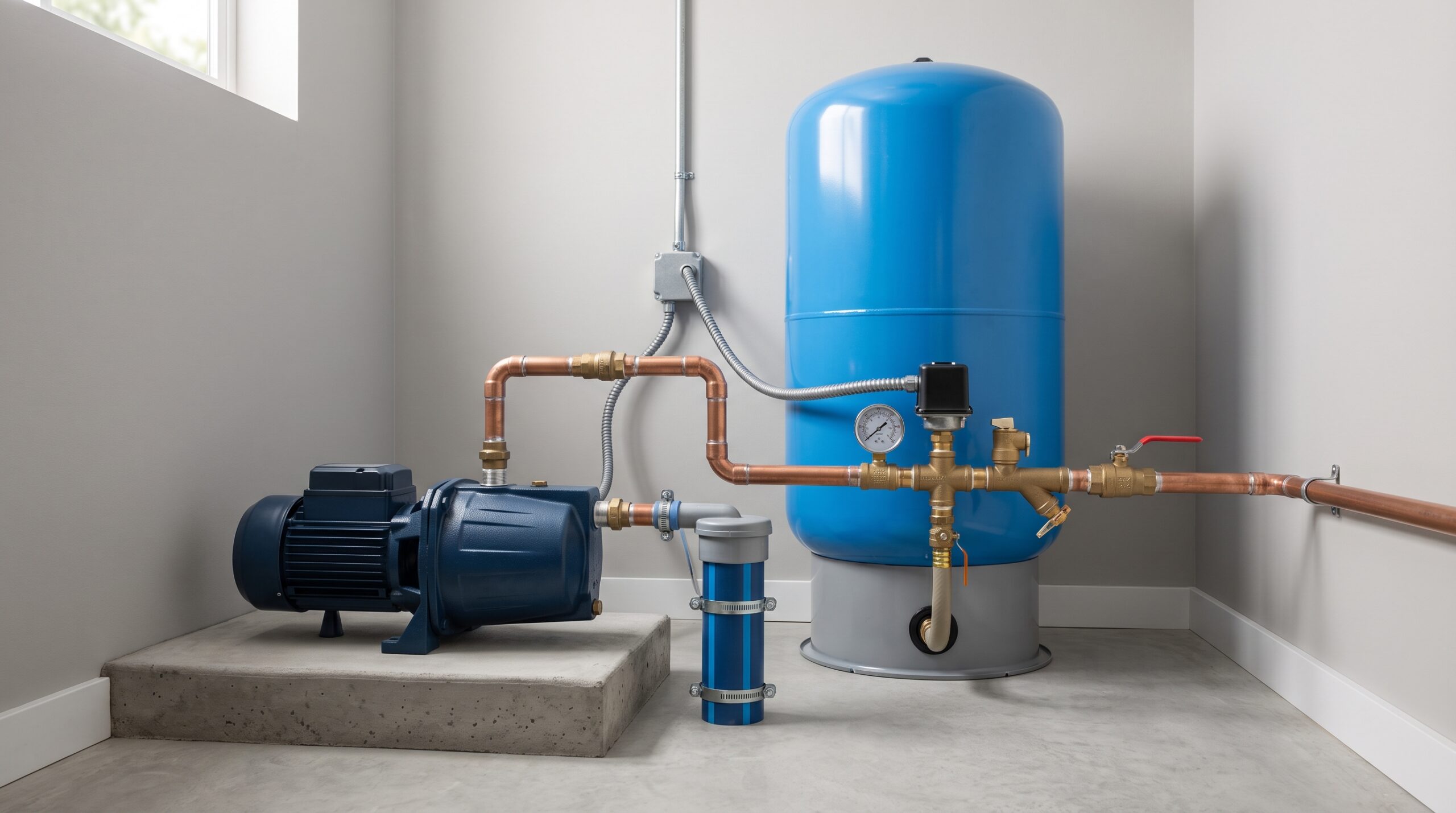
A pressure tank stores pressurized water between pump cycles. It helps maintain steadier water pressure and prevents the pump from starting every time a faucet is opened.
When a pressure tank loses its air charge, develops a damaged bladder, or is too small for the pump, the pump may start and stop every few seconds. This short cycling increases wear on the motor, pressure switch, and other starting components.
This pressure tank buying guide explains how to compare tank types, calculate the required drawdown, recognize common failure signs, and decide whether to recharge, repair, or replace the tank.
Quick Answer
For most residential shallow-well systems, a bladder pressure tank is the most practical choice.
- Choose the tank by its actual drawdown—not total tank capacity alone.
- Match it to the pump flow rate and pressure switch setting.
- Check the maximum working pressure and connection size.
- Look for reliable warranty coverage and available replacement parts.
Why You Can Trust ToollQ
This guide is based on 15 years of plumbing and hardware industry experience, including helping customers diagnose pressure tanks used with residential Jet Pumps and shallow-well systems.
One of the most common problems we see is a pump that starts and stops every few seconds because the pressure tank has lost its air charge, become waterlogged, or is too small for the system.
ToollQ Expert Insight
A larger tank is not automatically the right tank. The important number is how much usable water the tank provides between pump cycles at your actual pressure settings.
Before You Buy a Pressure Tank
Collect the following information before comparing models. Without it, tank sizing becomes guesswork.
- Pump flow rate: How many GPM can the pump deliver?
- Pump horsepower: Check the existing pump label.
- Pressure setting: Common examples are 30/50 or 40/60 PSI.
- Connection size: Match the existing plumbing and tank fitting.
- Installation space: Confirm whether the selected model is vertical or horizontal.
- Existing problem: Determine whether the tank is damaged or simply needs its precharge corrected.
How a Pressure Tank Works
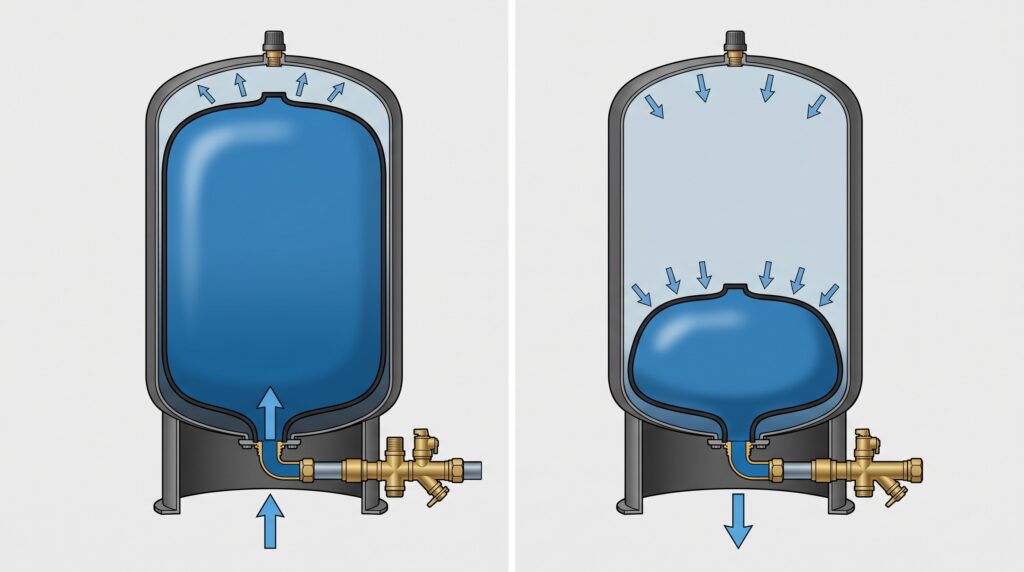
A residential well pressure tank contains water and compressed air separated by a bladder or diaphragm. The compressed air pushes stored water into the plumbing system when a faucet is opened.
- The pump fills the tank and compresses the air.
- The pump stops when pressure reaches the pressure switch cut-out setting.
- Stored water supplies the home while system pressure falls.
- The pump restarts when pressure reaches the cut-in setting.
A correctly sized tank gives the pump a reasonable running and resting period. An undersized or waterlogged tank provides very little usable water, causing rapid cycling.
Types of Pressure Tanks
Bladder Pressure Tank
A bladder tank uses a flexible bladder to keep water separated from compressed air. It provides stable performance and is widely available in many residential sizes.
Some models have replaceable bladders, while others require complete tank replacement after the bladder fails. Check the manufacturer’s design before buying.
Diaphragm Pressure Tank
A diaphragm tank uses a fixed flexible membrane to separate air and water. It also reduces air loss and provides reliable residential performance.
If the diaphragm fails, the complete tank usually needs replacement because the internal membrane is commonly fixed in place.
Air-Over-Water Pressure Tank
This traditional design stores water and air in the same chamber without a bladder. The air can gradually dissolve into the water, so the tank may need more frequent air-charge maintenance.
It can still work in an existing compatible system, but a bladder or diaphragm tank is normally more convenient for a new residential installation.
Do not confuse these products.
A well pressure tank controls pump cycling and stores pressurized water. A water heater expansion tank absorbs thermal expansion in a hot-water system. They are not interchangeable.
How to Choose the Right Pressure Tank
1. Check the Actual Drawdown
Drawdown is the usable amount of water delivered between the pressure switch cut-out and cut-in points. It is always lower than the tank’s total advertised capacity.
Compare the manufacturer’s drawdown chart at your actual pressure setting. The same tank can provide different drawdown at 30/50 PSI and 40/60 PSI.
2. Match the Tank to Pump Flow and Runtime
A simple sizing method is:
Required Drawdown = Pump Flow Rate × Desired Minimum Runtime
Always check the pump manufacturer’s minimum cycle-time recommendation. A one-minute runtime can be used as a basic residential example, but it is not a universal requirement for every pump.
3. Confirm the Pressure Switch Setting
The tank precharge is commonly set 2 PSI below the pressure switch cut-in setting. A 30/50 PSI system normally starts with a 28 PSI precharge, while a 40/60 PSI system normally starts with 38 PSI.
Turn off the power, drain all water, and confirm the system pressure is at 0 PSI before checking or adjusting the tank precharge. Follow the tank manufacturer’s instructions if they specify a different setting.
4. Check the Maximum Working Pressure
The tank’s maximum working pressure must safely exceed the system’s normal operating pressure. The pressure switch, relief valve, tank, pump, and plumbing must all be compatible.
5. Match the Connection and Installation Form
Confirm the inlet connection size before buying. Avoid reducing the pipe or fitting size unless the pump or tank manufacturer allows it.
Both vertical and horizontal tanks can work correctly. Choose according to the available space and the manufacturer’s approved installation position rather than assuming one orientation is always better.
6. Prioritize Quality and Serviceability
The outer tank material is not the only quality indicator. Pay closer attention to the bladder or diaphragm, working-pressure rating, connection quality, warranty, and access to replacement parts.
A low-priced tank can become expensive if no replacement bladder, technical support, or warranty service is available.
Simple Pressure Tank Sizing Example
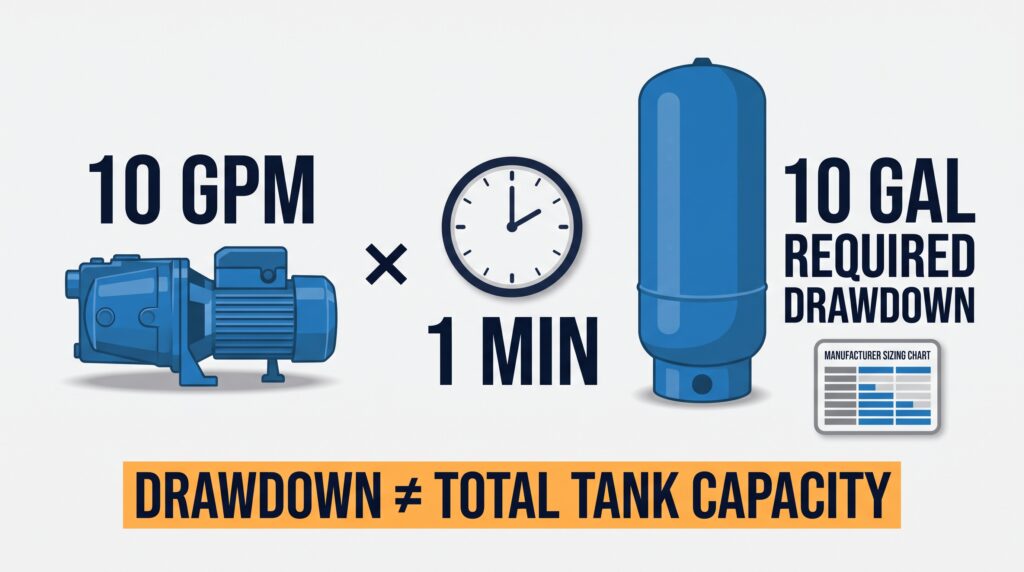
Example pump flow: 10 GPM (38 L/min)
Example minimum runtime: 1 minute
Calculation: 10 GPM × 1 minute = 10 gallons (38 L) of required drawdown
This does not mean you should buy a tank advertised as a 10-gallon tank. Find a model that provides at least 10 gallons of actual drawdown at your pressure switch setting.
For final selection, compare your calculation with the official sizing guidance from Amtrol or the Flexcon drawdown calculator.
If the pump manufacturer requires a longer minimum runtime, increase the required drawdown accordingly. Use the manufacturer’s sizing chart before making the final selection.
Common Buying Mistakes and Hidden Costs
Looking Only at Total Tank Capacity
Total tank capacity is not the amount of usable water available between pump cycles. Ignoring drawdown can result in a tank that is much smaller than expected.
Buying a Tank That Is Too Small
An undersized tank can make the pump start and stop too frequently. This places additional stress on the motor, pressure switch, capacitor, and other starting components.
Checking Precharge Without Draining the Tank
Water pressure inside the tank affects the air-pressure reading. Measuring before draining the system can produce an incorrect result and lead to improper adjustment.
Buying the Wrong Product or Connection
A well pressure tank is not a water heater expansion tank. Also confirm the connection size and approved installation orientation before purchasing.
Choosing Price Over Parts and Support
A low-cost tank may have limited warranty support or no replacement bladder. If a serviceable component cannot be purchased, the complete tank may need replacement.
Installing the Tank in a Wet Location
Rain, standing water, and constant dampness can accelerate external corrosion. A rusted or leaking tank may damage nearby equipment, flooring, or the pump installation area.
These mistakes can lead to unstable pressure, additional noise, higher repair costs, premature pump failure, and the cost of buying the correct tank a second time.
Real Customer Experience
System: Shallow well → Jet Pump → Pressure tank → Whole house
Symptom: The Jet Pump started and stopped every few seconds whenever a faucet was opened.
Diagnosis: The pressure tank had lost its precharge and become waterlogged, leaving very little usable drawdown.
Solution: The complete pressure tank was replaced.
Result: Pump cycles became longer, starts were reduced, and household water pressure became more stable.
This case shows why rapid cycling should not automatically be blamed on the pump. The pressure tank and system pressure should be checked before replacing a working Jet Pump.
Recharge, Repair, or Replace?
Recharge the Tank
If the tank body and bladder are still sound but the precharge is low, drain the system and restore the correct air pressure. Monitor the tank to confirm it can maintain the charge.
Repair the Tank
If a serviceable bladder has failed, replacing only the bladder may be possible. Compare the cost, tank age, and availability of the correct manufacturer-approved part before repairing it.
Replace the Complete Tank
Complete replacement is normally the safer choice when the fixed diaphragm has failed, the tank is undersized, or the body is rusted, cracked, deformed, or leaking.
An old tank with several problems may also cost more to repair than replace.
Signs Your Pressure Tank May Have Failed
- The pump starts and stops every few seconds.
- Water pressure rises and falls rapidly.
- Precharge is very low after the system is fully drained.
- Water comes out of the tank’s air valve.
- The tank feels unusually heavy or cannot drain normally.
- The tank quickly loses air again after being recharged.
- The tank body is rusted, deformed, cracked, or leaking.
Tapping the tank may help identify a waterlogged condition, but it should not be used as the only test. Drain the system and check the precharge correctly before reaching a conclusion.
Installation and Maintenance Tips
During Installation
- Place the tank on a stable, level base.
- Protect it from rain, standing water, and constant dampness.
- Install isolation and drain valves for future servicing.
- Use the correct connection size and approved orientation.
- Confirm that the pressure switch and relief protection suit the system.
During Maintenance
- Disconnect electrical power before servicing the pump system.
- Drain the tank and confirm 0 PSI before checking precharge.
- Inspect the tank, connections, and air valve for corrosion or leaks.
- Check the precharge annually or according to the manufacturer’s schedule.
- Never exceed the tank’s maximum working pressure.
ToollQ’s Choice and Final Recommendation
For most residential shallow-well Jet Pump systems, ToollQ recommends a quality bladder pressure tank sized by actual drawdown.
Calculate the required drawdown from the pump flow rate and manufacturer-recommended minimum runtime. Then use the tank manufacturer’s chart at your actual pressure switch setting.
Before buying, confirm the maximum working pressure, connection size, installation form, warranty, and availability of replacement parts. Do not choose by horsepower or total tank capacity alone.
Frequently Asked Questions
What size pressure tank do I need for a 10 GPM pump?
If the pump requires a one-minute minimum runtime, begin with 10 gallons of required drawdown. Select a tank that provides at least this drawdown at your actual pressure setting. The advertised nominal tank capacity will be larger than 10 gallons.
Is a bigger pressure tank better?
A larger correctly installed tank can reduce pump starts, but bigger is not automatically necessary. Compare the required drawdown, available space, connection size, pressure rating, and cost.
What should the pressure tank precharge be?
It is commonly set 2 PSI below the pressure switch cut-in setting. Check it only after turning off the pump, draining the water, and reducing system pressure to 0 PSI. Always follow the tank manufacturer’s instructions.
Why does my pump start and stop every few seconds?
Possible causes include low tank precharge, a ruptured bladder or diaphragm, a waterlogged tank, an undersized tank, a pressure-switch problem, or plumbing leakage. Test the system before replacing the pump.
Does water from the air valve mean the tank is damaged?
Yes. Water coming from the air valve is a strong sign that the bladder or diaphragm has failed. Replace the bladder only if the model is designed to be serviced; otherwise, replace the tank.
Can I use a water heater expansion tank with a well pump?
No. A thermal expansion tank and a well pressure tank perform different jobs and are not interchangeable. Use a tank specifically approved for the pump system.