How to Choose the Best Kitchen Faucet (2026 Buying Guide)
Choosing the best kitchen faucet isn’t just about appearance or price. The right faucet should match your daily cooking habits, fit your kitchen sink, and provide years of reliable performance.
In this 2026 buying guide, you’ll learn how to compare faucet materials, ceramic cartridges, faucet height, and everyday usability so you can avoid costly mistakes and choose the best kitchen faucet for your home.
Quick Answer
If you’re looking for the short answer, choose a kitchen faucet with a SUS304 stainless steel or solid brass body, a high-quality ceramic cartridge, and a size that matches your kitchen sink. These features offer the best balance of durability, smooth performance, and long-term value for most homeowners.
Why You Can Trust ToollQ
At ToollQ, we don’t recommend kitchen faucets based only on manufacturer specifications or marketing claims.
Our buying guides are built on practical plumbing and hardware knowledge, focusing on the features that truly matter in everyday use. We compare materials, durability, functionality, and long-term value to help homeowners make confident buying decisions.
Our goal is simple: help you understand what to look for before you buy, avoid common mistakes, and choose products that offer the best long-term value—not just the lowest price.
How to Choose the Right Kitchen Faucet Step by Step
Choosing a kitchen faucet doesn’t have to be complicated. Follow these five simple steps to narrow down your options and find a faucet that matches your kitchen, your budget, and your daily needs.
Step 1: Choose the Right Material
Start by selecting the faucet body material. For most homeowners, SUS304 stainless steel offers the best balance of durability and value, while solid brass is ideal if you’re looking for maximum longevity.
Want to understand the difference between stainless steel grades? Read our complete SUS304 vs SUS201 Stainless Steel guide.
For more information about stainless steel standards and applications, refer to the American Iron and Steel Institute (AISI).
Step 2: Check the Ceramic Cartridge
The cartridge controls water flow every day. Choosing a faucet with a high-quality ceramic cartridge helps reduce leaks and provides smoother operation over the years.
Step 3: Match the Faucet to Your Sink
Make sure the faucet height and spout reach fit your sink size. A well-matched combination makes washing dishes and large cookware much easier.
Choosing the right faucet is only part of the equation. Pair it with the right sink by reading our complete Best Kitchen Sink Buying Guide.
Step 4: Consider Daily Convenience
Think about features you’ll actually use, such as pull-out spray heads, swivel spouts, or dual spray modes. Don’t pay extra for features you won’t need.
Step 5: Focus on Long-Term Value
Instead of choosing the cheapest faucet, compare overall build quality, warranty, replacement parts, and expected lifespan. A better-built faucet often saves money over time.
ToollQ Tip
Buy the faucet you’ll still be happy using five years from now—not just the one that looks good on the shelf today.
Table of Contents
- Quick Answer
- Why You Can Trust ToollQ
- How Often Will You Use It?
- Choose the Right Body Material
- Check the Cartridge Quality
- Choose the Right Faucet Height
- Make Sure It Is Comfortable to Use
- Common Kitchen Faucet Buying Mistakes
- ToollQ Final Recommendation
- Frequently Asked Questions
1. How Often Will You Use It?
The kitchen faucet is one of the most frequently used fixtures in every home. Families who cook every day should choose a durable faucet with a high-quality ceramic cartridge for long-lasting performance.
2. Choose the Right Body Material
The faucet body material has a major impact on durability.
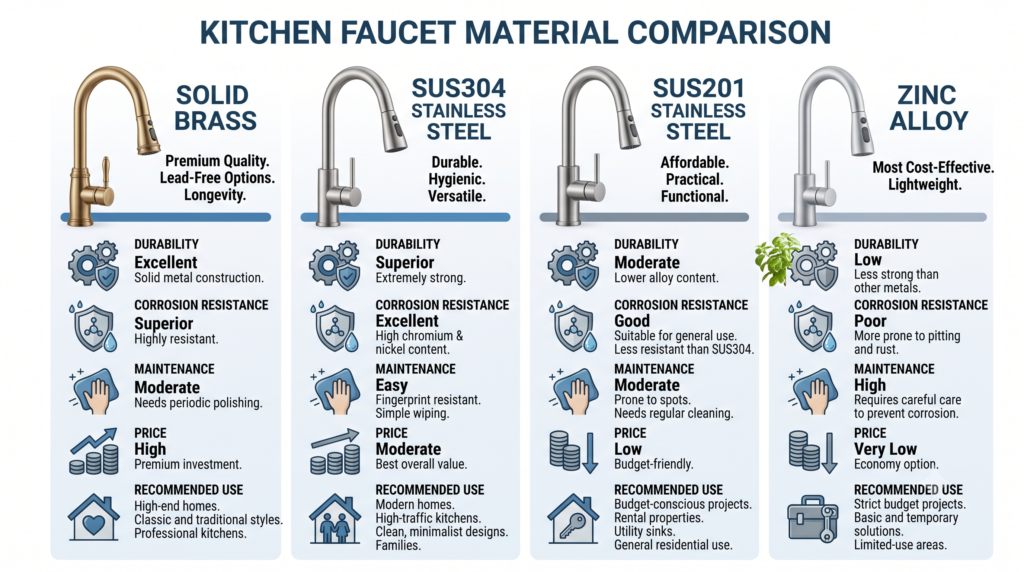
Solid Brass
Solid brass has long been considered one of the most durable materials for kitchen faucets. It offers excellent corrosion resistance, high strength, and can withstand years of daily use. Many premium kitchen faucets use solid brass because it is reliable, easy to repair, and performs well over the long term.
Pros:
- Extremely durable
- Excellent corrosion resistance
- Easy to repair and maintain
- Long service life
Best for:
Homeowners looking for maximum durability and long-term value.
SUS304 Stainless Steel
- Excellent corrosion resistance
- Suitable for long-term use
- Recommended for most homeowners
SUS304 stainless steel is one of the most popular choices for modern kitchens. It offers outstanding corrosion resistance, a clean contemporary appearance, and excellent durability without requiring heavy maintenance.
Pros:
- Rust resistant
- Food-safe material
- Easy to clean
- Modern appearance
Best for:
Most homeowners looking for excellent performance at a reasonable price.
SUS201 Stainless Steel
- More affordable
- Suitable for light-duty use
- Good option for smaller budgets
If your budget allows, SUS304 is usually the better long-term investment.
Zinc Alloy
Zinc alloy faucets are commonly found in entry-level products because they are less expensive to manufacture. While they may look attractive, they generally have a shorter lifespan than solid brass or SUS304 stainless steel faucets.
Pros:
- Affordable
- Lightweight
- Suitable for low-use areas
Cons:
- Lower durability
- Shorter service life
- Not ideal for heavy daily use
Best for:
Rental properties or homeowners with a very limited budget.
Quick Material Comparison
| Material | Solid Brass | SUS304 Stainless Steel | SUS201 Stainless Steel | Zinc Alloy |
| Durability | Excellent | Excellent | Good | Fair |
| Corrosion Resistance | Excellent | Excellent | Moderate | Fair |
| Price | $$$ | $$ | $ | $ |
| Best For | Long-term homeowners | Most homeowners | Budget-conscious buyers | Light-duty or rental properties |
There is no single best faucet material for everyone. The right choice depends on your budget, how often you use your kitchen, and how long you expect the faucet to last. For most homeowners, SUS304 stainless steel offers the best balance of durability, corrosion resistance, and value.
3. Check the Cartridge Quality
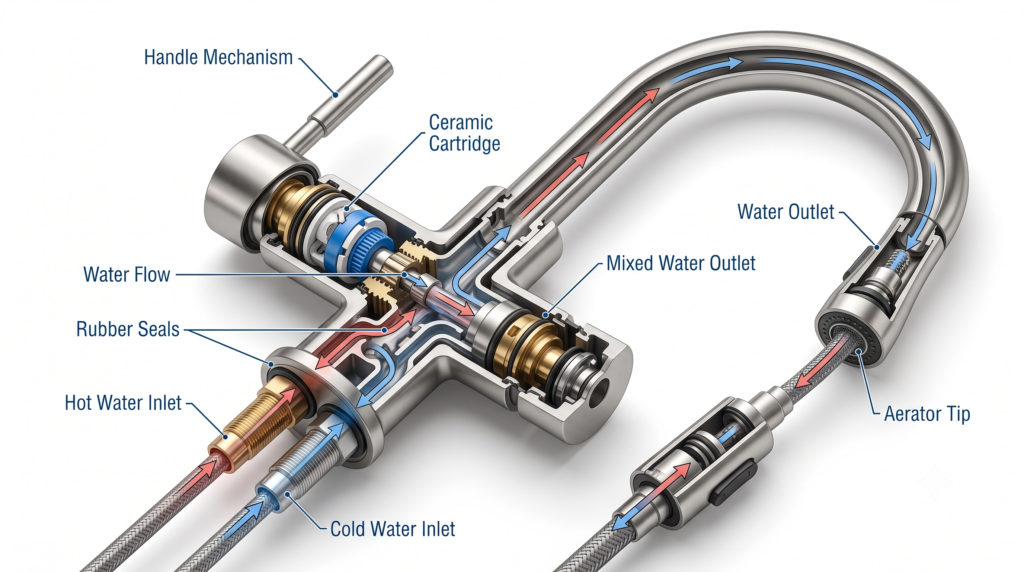
The cartridge is the heart of every faucet because it controls water flow.
A ceramic cartridge is one of the most important components inside a kitchen faucet. Although it cannot be seen from the outside, it directly affects how smoothly the faucet operates and how long it will last.
A high-quality ceramic cartridge can withstand hundreds of thousands of on-and-off cycles, helping reduce leaks and ensuring consistent water flow for many years.
A high-quality ceramic cartridge provides:
- Smooth operation
- Longer lifespan
- Better leak resistance
- Lower maintenance costs
Avoid choosing a faucet based only on appearance. The cartridge quality is often more important than the exterior design.
How to Choose a Good Ceramic Cartridge
When comparing kitchen faucets, don’t focus only on the exterior finish. Ask about the cartridge inside.
A quality ceramic cartridge should provide:
- Smooth handle movement
- Consistent water flow
- Excellent leak resistance
- Long service life
If the product specification doesn’t mention the cartridge at all, it’s worth asking the seller before making a purchase.
For information about health and safety standards for kitchen products, visit NSF International.
ToollQ Tip: A beautiful faucet may catch your attention, but the ceramic cartridge determines how well it performs every single day. Never judge a faucet by its appearance alone.
4. Choose the Right Faucet Height
Before buying, consider your sink size.
The height and reach of a kitchen faucet can significantly affect everyday comfort. A faucet that is too low may make it difficult to wash large pots and pans, while one that is too high can cause excessive splashing, especially with shallow sinks.
Before choosing a faucet, consider:
- The depth of your kitchen sink
- The size of the cookware you use most often
- The available space beneath upper cabinets
- Whether you prefer a standard or high-arc spout
Choosing the Right Faucet Height
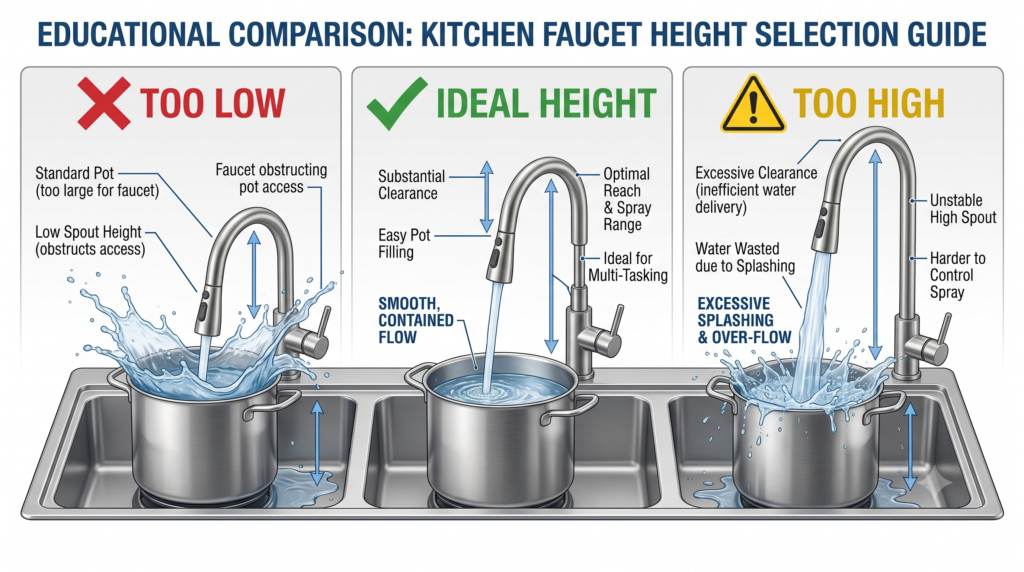
For most modern kitchens, a medium to high-arc faucet provides the best balance between convenience and splash control. However, always make sure the faucet proportions match your sink size and countertop layout.
ToollQ Tip
Many buyers only look at the faucet itself. Always imagine using your largest cooking pot under the faucet before making your final decision.
5. Make Sure It Is Comfortable to Use
A kitchen faucet is one of the most frequently used fixtures in your home, so everyday comfort matters just as much as durability.
When comparing different models, think about how the faucet will actually feel during daily use—not just how it looks in the showroom.
- A handle that is easy to operate with wet hands
- Smooth and precise water flow control
- A spout reach that comfortably covers the sink
- A finish that is easy to clean and maintain
- Enough clearance for washing large cookware
Features That Improve Everyday Convenience
Modern kitchen faucets often include features such as pull-out spray heads, swivel spouts, or dual spray modes. While not every household needs these features, they can make food preparation, dishwashing, and sink cleaning much easier.
ToollQ Tip
The best kitchen faucet is the one that feels effortless to use every single day. Small details like handle comfort, spout reach, and smooth operation often make a bigger difference than appearance alone.
Common Kitchen Faucet Buying Mistakes
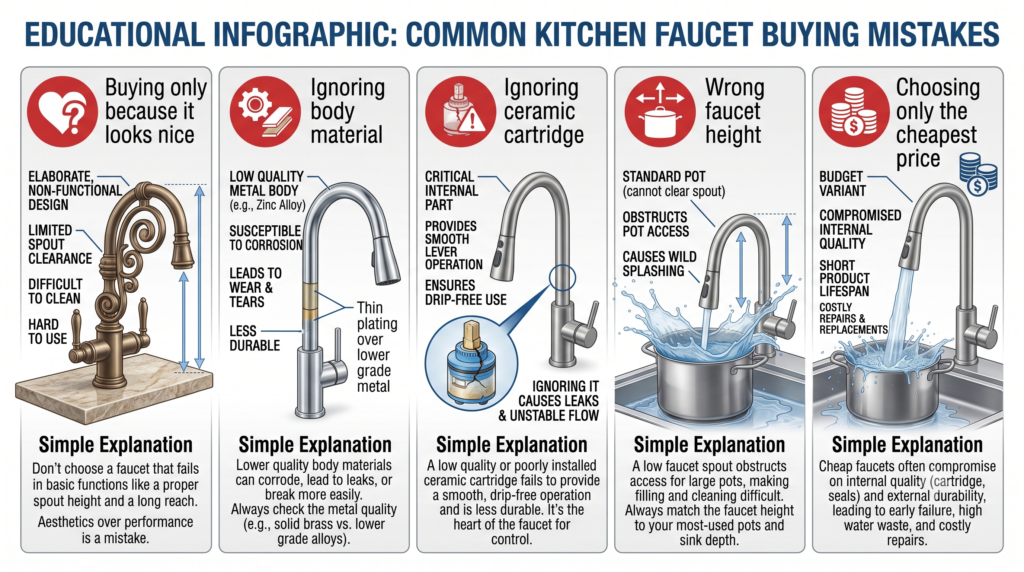
Many homeowners focus only on price or appearance when buying a kitchen faucet. However, the most expensive faucet isn’t always the best, and the cheapest option often leads to higher replacement costs in the future.
Before making a purchase, pay attention to the faucet body material, ceramic cartridge quality, faucet height, and how well it matches your kitchen sink and daily cooking habits.
✓ Choosing based only on appearance
✓ Ignoring the faucet body material
✓ Overlooking ceramic cartridge quality
✓ Buying a faucet that doesn’t fit the sink
✓ Focusing only on the lowest price
ToollQ Buying Checklist
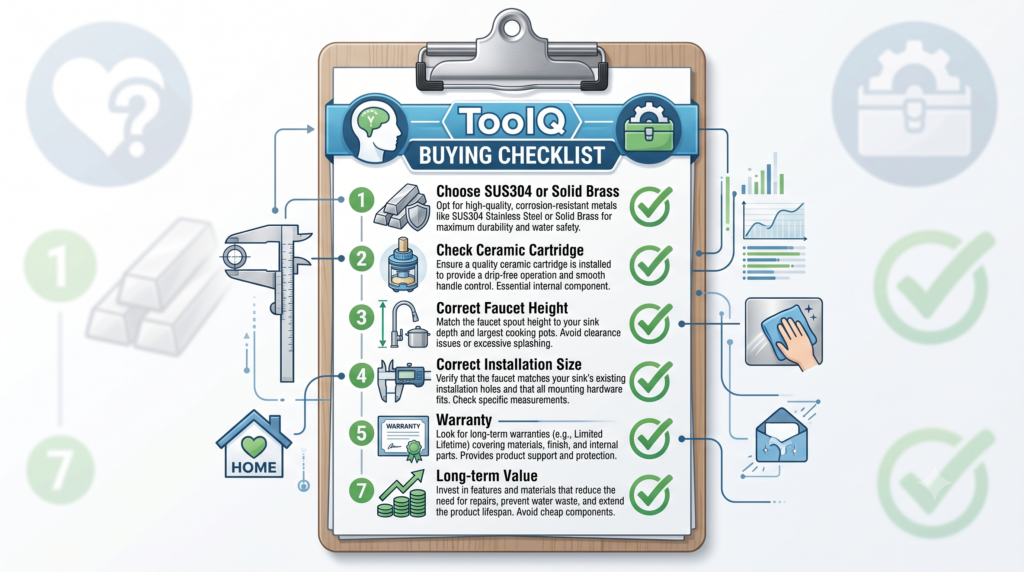
Before you make your final purchase, use this quick checklist to make sure you’ve considered the most important factors. Spending a few extra minutes now can help you avoid costly mistakes later.
✅ Choose SUS304 stainless steel or solid brass whenever possible
✅ Look for a high-quality ceramic cartridge
✅ Match the faucet height and spout reach to your sink
✅ Make sure the installation size fits your countertop
✅ Check the warranty and availability of replacement parts
✅ Consider how easy the faucet will be to clean
✅ Compare long-term value instead of only the purchase price
Looking for more plumbing buying guides and expert tips? Explore our Plumbing Solutions collection for more helpful articles.
ToollQ Recommendation
If you can confidently check every item above, you’re much more likely to choose a kitchen faucet that delivers reliable performance for years to come.
ToollQ Final Recommendation
If we were choosing a kitchen faucet for our own home, we would prioritize long-term reliability over short-term savings.
For most homeowners, a SUS304 stainless steel or solid brass faucet with a high-quality ceramic cartridge offers the best balance of durability, smooth operation, and long-term value. Choosing the right height and a comfortable handle design will also improve your everyday kitchen experience.
ToollQ Tip: A kitchen faucet is one of the most frequently used fixtures in your home. Spending a little more on better materials and internal components can often save money on repairs and replacements over the years.
Conclusion
Choosing the best kitchen faucet is not only about appearance or price. By considering usage frequency, body material, cartridge quality, faucet height, and ease of use, you can make a smarter decision and avoid unnecessary replacement costs.
For additional kitchen planning ideas and professional recommendations, visit the National Kitchen & Bath Association.
Frequently Asked Questions
Is SUS304 better than SUS201?
Yes. SUS304 generally offers better corrosion resistance and a longer service life, making it a better choice for most kitchens.
How long should a kitchen faucet last?
A quality kitchen faucet with a ceramic cartridge can last many years when properly installed and maintained.
What is the most important part of a faucet?
The cartridge is one of the most important components because it controls water flow and greatly affects durability.
How long should a good kitchen faucet last?
A high-quality kitchen faucet made from SUS304 stainless steel or solid brass with a ceramic cartridge can typically last 10 to 20 years with proper maintenance. Actual lifespan depends on water quality, usage frequency, and installation.
Is SUS304 better than brass for kitchen faucets?
Both materials are excellent choices. SUS304 stainless steel offers outstanding corrosion resistance and modern aesthetics, while solid brass is known for its durability and long service life. The better option depends on your budget and personal preference.
What is the most important part of a kitchen faucet?
The ceramic cartridge is one of the most important components because it controls water flow and helps prevent leaks. A high-quality cartridge can greatly improve the faucet’s lifespan and daily performance.
If you’re planning a complete kitchen upgrade, don’t stop at choosing the right faucet. Learn how to select the perfect sink to match it in our Best Kitchen Sink Buying Guide, and explore the differences between SUS304 vs SUS201 stainless steel before making your final decision.